

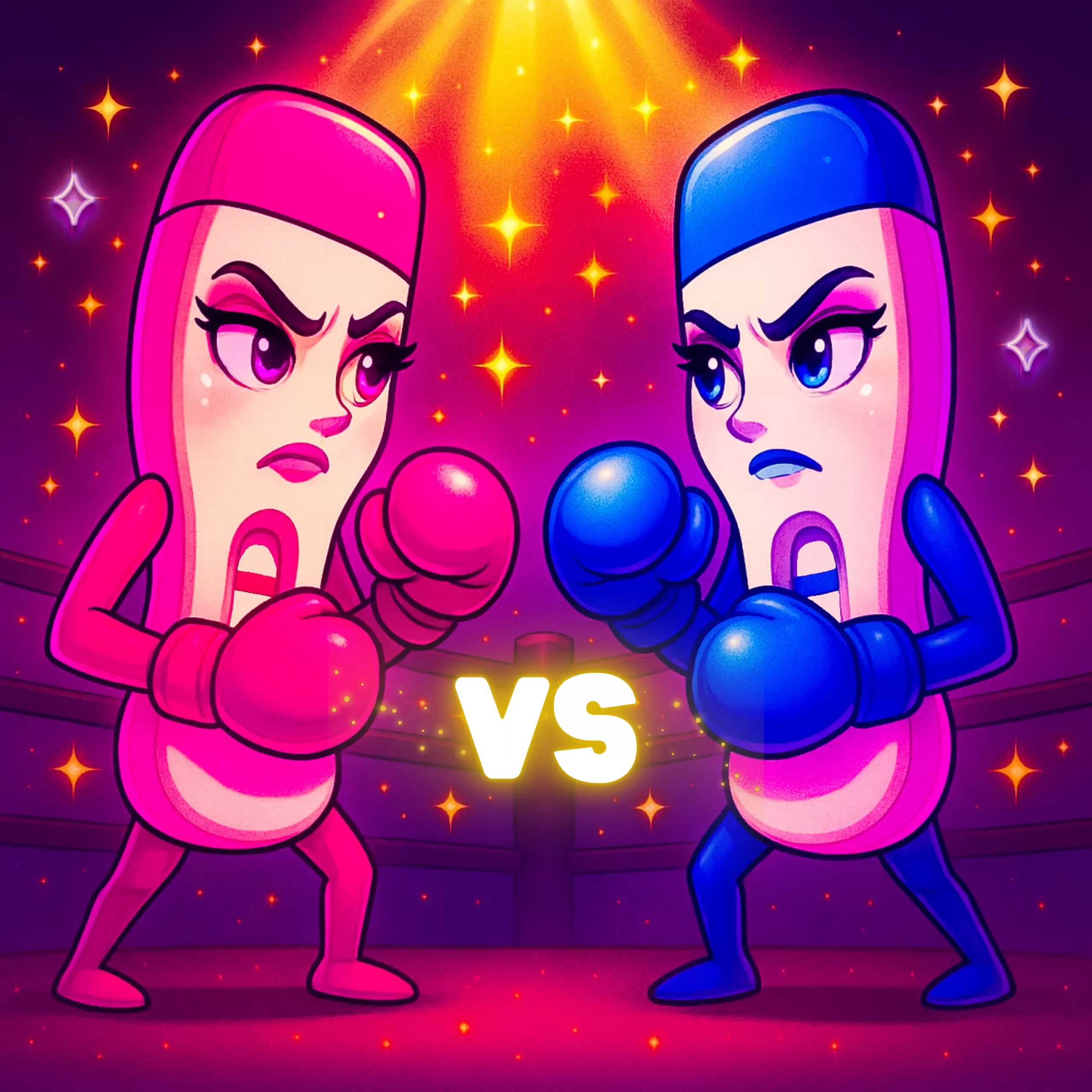
If you’ve ever found yourself squinting at a pregnancy test like it’s a magic eye puzzle, you’re not alone.
The internet is buzzing with debates over whether pink dye or blue dye pregnancy tests are “better.”
Here’s the truth: the color of the line does not determine accuracy.
Both types work on the same science – detecting hCG in urine – but pink dye tests often feel more reliable because they’re easier to read and less likely to show confusing evaporation lines. Add to that the fact that some of the most sensitive brands (like First Response Early Result) happen to use pink dye, and it’s easy to see why pink has the reputation for being “better.”
Still, the real difference comes down to the test’s design, sensitivity cutoff, and which hCG forms it can detect, not just the color.
So, before we pit pink against blue in the ultimate showdown, let’s peek behind the curtain at how these little sticks actually work. Spoiler: it’s all about science, nothing to do with the dye drama.
💜 Skip to the Good Stuff

How Pregnancy Tests Work: The Science Behind the Lines
Pregnancy tests might look like simple little sticks, but they’re secretly mini science labs. From that first drop of pee to the moment a line shows up, a lot is going on behind the scenes. Let’s break it down.
The Role of hCG in Early Pregnancy
Every test is hunting for one thing – hCG, aka the “you’re pregnant” hormone. It appears a few days after implantation and increases rapidly in early pregnancy, doubling approximately every two to three days. Fun fact? The earliest version your body makes is called hyperglycosylated hCG, and not all tests are designed to catch it. That’s why some brands get results sooner than others.
The Lateral Flow Process Explained
When urine hits the test strip, it moves upward through capillary action – the same process that makes a paper towel soak up a spill. Along the way, the strip is coated with antibodies (proteins designed to detect very specific molecules). If hCG is present, those antibodies grab onto it and drag tiny dye particles into one location. That cluster of dye is what becomes your visible test line.
Why the Lines Turn Pink or Blue
Think of it as different outfits for the same science. Pink dye tests usually rely on colloidal gold – microscopic particles of gold (more below) that look reddish-pink to the human eye. Blue dye tests, on the other hand, often use dyed latex, which shows up as blue streaks on the strip. Both particles are just labels to make the antibody–hCG reaction visible.
The real accuracy depends on the antibody design and the hCG concentration cutoff, not whether the line shows up pink or blue.
Control vs Test Line: What Each Means
- The control line confirms that the test worked correctly and urine flowed through the strip.
- The test line appears only if hCG was detected. If the control line never appears, the test is invalid, regardless of the dye color.

Pink Dye vs Blue Dye Pregnancy Tests: What’s the Real Difference?
Both pink and blue dye tests are built on the same immunoassay science, but the experience of reading them can feel completely different. Here’s why TTC communities keep debating which one’s better.
Visual Clarity and Readability
Pink dye tests tend to look sharper because they use colloidal gold nanoparticles. These tiny particles scatter light in a way called surface plasmon resonance, which makes them appear reddish-pink against the white background of the test window. That sharp contrast makes faint positives easier to spot. Blue dye tests often rely on dyed latex microspheres, which can spread or streak as urine dries. This sometimes leaves the result looking blurry, which adds to the frustration of line-squinting at 6 a.m.
Evaporation Line Confusion
- On pink dye tests, evaporation lines usually dry light gray. Annoying, yes, but most people can tell they are not true positives.
- On blue dye tests, evaporation lines can leave behind faint blue streaks, which look dangerously close to a real positive and spark endless TTC forum debates.
Science vs Perception
Here’s the important takeaway: the dye color is just the label that makes the reaction visible. What truly determines performance is the antibody specificity (whether it detects hyperglycosylated hCG early on) and the sensitivity cutoff (the lowest hCG level the test reports as positive). Still, because popular pink dye tests combine strong sensitivity with clearer readability, TTC communities have built a perception that pink dye tests are the gold standard.

Accuracy: Are Pink Dye vs Blue Dye Pregnancy Tests Better?
This is the million-dollar question. Spoiler alert: the dye color itself isn’t what makes a test more accurate. Accuracy depends on three things:
- Sensitivity cutoff (how low of an hCG level the test can detect)
- Which form of hCG are the antibodies designed to catch
- User technique (timing, reading window, urine concentration)
Because some of the most sensitive brands happen to use pink dye, the reputation of being “better” stuck around.
Sensitivity Cutoffs: How Early Can Each Test Detect hCG?
Pregnancy tests are cleared to turn positive at a set sensitivity cutoff, usually between 6 and 25 mIU/mL of hCG. The lower the number, the earlier you can get a positive. For example, First Response Early Result (FRER), a pink dye test, has shown positives at about 6.3 mIU/mL and is nearly consistent by 12 mIU/mL. Compare that to many store-brand tests, often blue dye, which stick closer to 25 mIU/mL. That’s why pink dye tests feel more accurate; they can confirm pregnancy days earlier.
And if you’re staring at a stark negative specifically around 10 DPO, our guide to 10 DPO BFN breaks down why you may still be testing too early.
Which hCG Form the Test Recognizes
As mentioned earlier, in the very first days after implantation, your body produces hyperglycosylated hCG (h-hCG). Some tests are built with antibodies that latch onto this early version, while others aren’t. Tests that do pick it up tend to give earlier positives, and many of those are pink dye brands. Think of it like different phone chargers – some work universally, while others only fit one outlet. This is supported by a scientific review on early pregnancy test sensitivity.
User Error and Evap Lines
Even the best test can mislead if it’s read too late or in poor lighting. Evaporation lines are sneaky, especially on blue dye strips, because they can dry with a faint blue tint that looks real. Pink dye tests aren’t immune, but their evaps usually dry gray, which makes them easier to dismiss. This is why TTC forums are flooded with “line eyes” posts – everyone is trying to tell an evap from a true positive.
Digital vs Line Tests
Digital tests, whether they’re backed by pink or blue strips inside, simplify the process by spelling out “Pregnant” or “Not Pregnant.” The trade-off? Many digitals require slightly higher hCG levels (closer to 25 mIU/mL), so they can miss super early pregnancies that a sensitive pink dye test would catch. Think of them as the honest friend who tells you the truth, but only once they’re completely sure.

Evaporation Lines Explained: Why They Happen and How to Spot Them
Few things cause more heartbreak and confusion than staring at a test and wondering if that faint line is real. Evaporation lines – or “evaps” (check out our full list of TTC Acronyms) – are the ghost lines of pregnancy testing. Here’s the science behind them, and how to tell the difference between an evap and a true positive.
What Evaporation Lines Really Are
When urine dries on the test strip, it can leave behind crystals and streaks that catch the light in a way that looks like a faint line. Because the dye can sometimes collect in those dry spots, especially in blue dye tests, it may even take on color. This has nothing to do with hCG or a true pregnancy signal – it’s a drying artifact, not a biochemical reaction.
Why They Happen More on Blue Dye Tests
- Blue dye molecules tend to spread across the test strip, which makes streaks look more like real positives.
- Pink dye tests usually leave evaps that dry gray or colorless, making them easier to dismiss.
How to Spot the Difference Between an Evap and a Positive
Evap lines often show up after the time limit listed in the instructions, usually 10 minutes or more. A true positive appears within the testing window and typically gets darker with repeat testing over the next day or two. Pro tip? Always check in good light – bathroom shadows and 3 a.m. eyes are not your friends here.
Tips to Avoid the Heartbreak
- Read results within the official time window (usually 3–10 minutes).
- Use first-morning urine when possible for the highest hCG concentration.
- When in doubt, test again in 48 hours – true hCG levels double fast if pregnancy is progressing healthily.

False Positives and Negatives: Causes Beyond the Dye Color
A faint line that vanishes the next day. A negative test when symptoms scream otherwise. False results can be crushing, but here’s the truth: they can happen for reasons that have nothing to do with pink or blue dye.
What Causes False Positives?
A positive result without an ongoing pregnancy is rare, but possible. Common causes include:
- Fertility medications containing hCG, which can trigger a temporary positive.
- Perimenopause or menopause, where the pituitary gland sometimes releases low levels of hCG.
- Medical conditions: Certain tumors can also produce hCG, but these cases are very rare.
What Causes False Negatives?
A negative result when you’re actually pregnant usually happens because of timing or concentration. Testing too early, testing later in the day with diluted urine, or using a test with a higher sensitivity cutoff can all lead to false negatives. Later in pregnancy, high levels of a breakdown product called the hCG beta core fragment can sometimes confuse certain antibody designs, causing inaccurate results. Shockingly, a small percentage of women are pregnant but just never test positive, too!
The Role of Test Design
The antibody chemistry built into each brand plays a huge role. Some tests are tuned to catch hyperglycosylated hCG in early pregnancy. Others are better at avoiding interference from fragments later in pregnancy. This is why brand choice matters more than dye color.
When to Retest or See a Doctor
If your results are unclear – faint lines, conflicting tests, or symptoms that don’t match the results – retest after 48 hours. hCG should rise enough to give a clearer answer. If confusion continues, a blood test at the doctor’s office is the gold standard. Notice any heavy bleeding coupled with pregnancy symptoms? Seek medical attention ASAP.

Most Accurate Pregnancy Tests on the Market Right Now
Not all tests are created equal. While every box promises “over 99% accuracy,” the fine print usually means “from the day of your missed period.” If you’re testing early, brand choice makes a huge difference. Here are the standouts that our TTC babes and clinical data both back up.
First Response Early Result (FRER)
This pink dye classic is famous for catching pregnancies days before a missed period. FDA studies show it can detect hCG as low as 6.3 mIU/mL, with nearly consistent positives by 12 mIU/mL. In plain English? FRER is one of the most sensitive home tests you can buy. No wonder it’s the go-to in TTC forums.
Clearblue Early Detection
Clearblue’s blue dye tests are widely available worldwide and often include a sleek digital option. Their early detection version has an analytical sensitivity of around 10 mIU/mL, making it competitive with FRER. The brand also designed its antibodies to avoid false positives from pituitary hCG, which can appear in perimenopause.
Digital Options
Digital tests remove the guesswork by spelling out “Pregnant” or “Not Pregnant.” Inside, most still use either pink or blue dye strips. Sensitivity is usually set at 25 mIU/mL, so they might not catch super early pregnancies, but they shine when it comes to avoiding line-squinting stress.
Store Brands, Cheapies, and Online Favorites
Not everyone wants to spend $15 a pop on FRER – and honestly, who can blame them when testing every day during the TWW? This is where budget tests shine. Most store brands and “cheapies” (like the internet-famous Wondfo and Easy@Home strips) are cleared at 25 mIU/mL. That means they’re best used from the day of your missed period rather than super early testing.
The perk? They’re affordable, often sold in bulk packs, and still very reliable once hCG levels are high enough. TTC babes love them for daily “POAS” (pee on a stick) marathons, since you can test repeatedly without feeling guilty about the cost. Pair them with a high-sensitivity test like FRER if you want to double-check a VVVFL. Yes, we’re looking at you, bestie!
FAQs: Common Questions About Pink and Blue Dye Tests
Pink dye tests feel more accurate because they’re easier to read, and many of the most sensitive brands (like FRER) use pink dye. But technically, accuracy comes from sensitivity cutoffs and antibody design, not the color of the line.
First Response Early Result (FRER) is the standout, with detection as low as 6.3 mIU/mL and nearly consistent positives by 12 mIU/mL. Clearblue Early Detection also performs well, with sensitivity around 10 mIU/mL and antibody designs that help avoid false positives from pituitary hCG. Most cheapies and standard store brands are cleared at 25 mIU/mL, which means they’re reliable from the day of a missed period but not for super early testing.
For early testing, FRER wins for sensitivity. For avoiding misreads, digitals are the most reliable since they literally spell it out for you – though they usually need higher hCG levels to turn positive.
Evaps can technically happen on any test, but blue dye strips are more notorious because their lines can dry with a faint blue tint. Pink dye evaps usually dry gray or colorless, which makes them easier to spot as false.
It can happen, but faint blue lines are trickier to trust. Always retest in 48 hours or use a pink dye or digital for confirmation. A true positive should darken as hCG levels rise.
It’s a test that uses latex-dye particles to show results in blue rather than pink. Brands like Clearblue often use this format. The dye color is purely visual; it doesn’t affect accuracy.
Yes, but so can pink dye tests. False positives are rare but possible with fertility meds or certain medical conditions. False negatives are more common, especially if you test too early, use diluted urine, or pick a test with a higher cutoff.
To Sum It Up
So here’s the tea, bestie: the color of the line doesn’t decide the truth of your pregnancy test. Pink dye tests often feel more trustworthy because they’re easier to read, and some of the most sensitive brands happen to use them. But at the end of the day, what really matters is the science inside the stick – the antibodies, the hCG cutoff, and how carefully you follow the instructions.
If you’re testing early, go for a proven sensitive option like First Response Early Result or Clearblue Early Detection. If you’re testing later, cheapies like Wondfo or Easy@Home are perfectly reliable and way easier on the wallet. And if you want zero guesswork? A digital will spell it out loud and clear.
Pregnancy testing can feel like a rollercoaster of emotions – especially when evap lines or faint shadows mess with your head. But remember, you’re not alone in this. We’re your girls’ girl corner of the interwebs, here to remind you that the line color is not your destiny.
💌 Got questions? Need a hype woman or just a bestie to cheer you on? Drop us a note in the form below. We love hearing from you, and no question is too small (or too TMI). We’ve got you, babe.









I ɑm gеnuinely delighted to glance at this website posts ԝhich includes tons of useful information, thanks for providing such
information.